
How Wholesale Custom Jewelry Runs Are Scheduled
Scheduling a custom jewelry wholesale run is simpler than it looks once the touchpoints are separated from the durations. Three durations are published — CAD back within allow allow allow allow 48 hours for CAD, 25–30 days for the master, 3–4 weeks for bulk for bulk for bulk in production for bulk for production — and five inspection points sit inside them, from after casting through to before packing. A schedule that names only the durations hides half the work.
Key takeaways
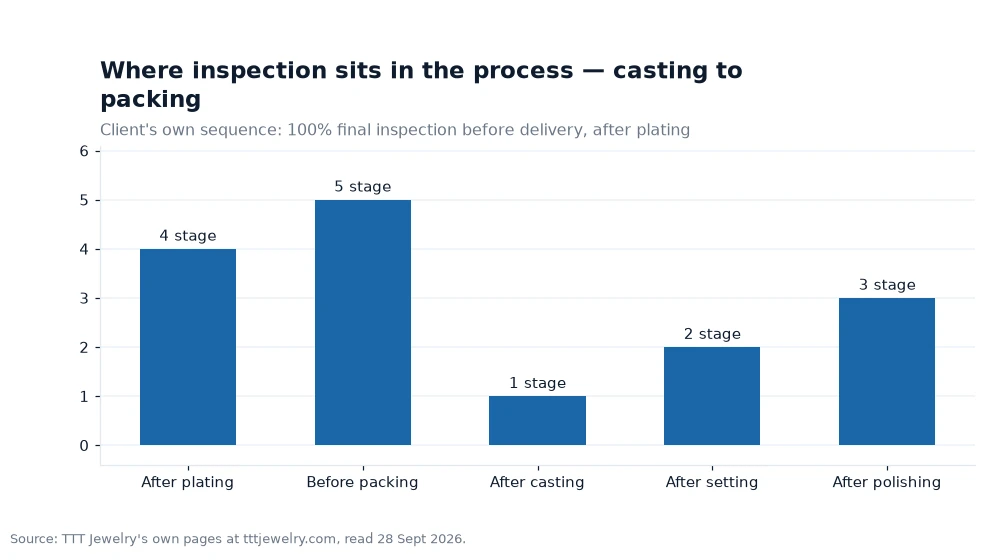
- Five inspection checkpoints run after casting, after setting, after polishing, after plating and before packing.
- CAD is published at under 48 hours, sampling at 25–30 days and production at 3–4 weeks.
- Order floors are 100 units in the eco-brass line, 50 units in sterling silver and 100+ pcs in stainless, design by design, with each design counted separately.
- Inspection covers 100% of pieces, so the last checkpoint is a full pass rather than a sample.
The published schedule in six stages
A run moves through six named stages: inquiry, consultation and development, CAD and prototype, sample and approval, bulk production, and final quality control and delivery. Only three of those carry a duration, and the three are the ones clients plan around.
The stages without a number are not empty. Consultation covers feasibility, material selection and the cost structure, and it is where a design that cannot be cast cleanly is stopped before a deposit changes hands.
Reading the list as a schedule rather than a sales sequence is the first step towards planning a launch date that survives contact with a workshop.
There is a second published sequence, and it is the one a wholesale buyer meets first: five service steps running concept and design, master sampling, quality inspection, sample confirmation, then mass production. The two lists describe the same work at different resolutions, and neither changes the durations — the five-step version simply names the confirmation gate that the six-stage version spreads across sample, approval and quality control.
Scheduling around the sampling window
Sampling spans 25–30 days and contains five operations: wax printing in 3D → casting in a precision mould → setting the stones → bench polishing → custom plating. Each operation is a bench with a queue, and a piece moves through them in order.
That means a schedule built only from the total window is a schedule with no slack points written into it. Taking the window as five to six days per operation is a workable planning assumption, and it shows immediately why a late stone change is expensive.
It also shows where a parallel run can be started., so the second design costs another 50 to 100 pieces the same tooling cycle, which is the practical reason a two-design order is often no longer than a one-design order.
Where inspection actually sits
Inspection is not one event at the end. The published sequence puts checks after casting, after setting, after polishing, after plating and before packing, which adds up to five checkpoints across the run.
Each checkpoint answers a different question. After casting catches porosity and short fills. After setting catches a loose or misaligned stone. After polishing catches a wheel mark. After plating catches a thin or uneven coat. Before packing confirms the count, the finish and the packaging.
The final pass covers 100% of pieces rather than a sample, so a defect that survives the earlier checkpoints does not reach a carton.
MOQ and batch size as schedule inputs
The entry quantities are 100 pcs in artisan brass, 100 plus in the stainless line and 50 in 925 sterling silver, per design, with each design counted separately. Batch size changes how long each operation takes, but it does not change the order of operations or remove a checkpoint.
That distinction matters when a buyer tries to negotiate time by ordering more. A larger quantity does not buy a shorter sampling window, because the sample itself is a one-off built to the design rather than a slice of the production run.
Where quantity does help is in spreading the fixed work across more pieces: the mould, the CAD drawings and the plating setup are paid once, whether the run is 50 pieces or 500.
How the schedule is published, and how to use it
The most useful thing a buyer can do is compare a supplier's stated process against a published one. The staged breakdown at https://www.tttjewelry.com/custom-jewelry-wholesale/ names the six stages, the three durations and the eight factory steps, which makes it possible to ask about a specific step rather than about lead time in general.
Specific questions get specific answers. Asking when inspection happens tends to produce a real answer; asking how long production takes produces whatever the last quotation said.
A schedule that survives is the one where each stage has a name, an owner and a date attached to it.
What makes a published schedule slip
Two things cause most slippage, and neither is the workshop. The first is approval latency: a sample that sits on a desk for a week adds a week, and the published 24-hour response standard exists to keep questions from pooling.
The second is a specification change after approval. Once tooling is cut and a finish is agreed, a change to the plating or the stone reopens settings, polishing and plating rather than adjusting a drawing, so the cost is measured in bench days.
A one-on-one project manager is the published answer to both problems. One named person holding the schedule catches a stalled approval before it eats a week, and it removes the handover where a question gets answered twice, differently.
| Stage | Published window | What it blocks |
|---|---|---|
| 3D CAD and renderings | under 48 hours | Tooling and sampling start |
| Master sampling | 25–30 days | Bulk production |
| Bulk production | 3–4 weeks | Packing and shipment |
| Final inspection | 100% of pieces | Whether the batch ships at all |
Worked example: five checkpoints across eight factory steps
The factory publishes eight production steps and five inspection checkpoints. Express the checkpoints as a share of the steps: 5 ÷ 8 = 62.5%, so roughly two thirds of the step list has a quality gate attached to the end of it.
Now total the calendar. CAD at 48 hours is 2 days, sampling at the slow end is 30 days, and production at the slow end is 28 days: 2 + 30 + 28 = 60 days, or about 8.6 weeks.
Both calculations are mine, the underlying numbers are published. The point of putting them together is that the checkpoints and the durations are two different ways of describing the same run, and a schedule needs both.
Frequently asked questions
How many inspection points are in a production run?
Five: after casting, after setting, after polishing, after plating, and before packing, with the final pass covering 100% of pieces.
Does a bigger order shorten the sampling window?
No. Sampling is published at 25–30 days and produces a one-off master sample built to the design, so batch size changes the production run rather than the sample.
What is the minimum order quantity for a custom run?
The minimums are 50 pieces in 925 sterling silver, 100 pcs in artisan eco-brass and 100+ pcs in stainless, counted per design.
Building a schedule that has checkpoints in it
A date and a checkpoint belong together, so the plan should name both. The six-stage OEM/ODM process is the version to hold a supplier against, because each stage ends at something that can be signed rather than discussed.
Where the run involves plated silver, the sterling silver production details also decide how many of the five checkpoints fall after the plating step, which is the one place a defect can hide under a finished surface.
The basis for every figure above — the six customisation options, production over 3–4 weeks, the packaging set — is the brand's own pages via tttjewelry.com on 28 Sept 2026. Nothing else here is inferred. The sums that follow from those inputs are my own working, not the site's[1].